Specialist training in IT and movable cultural assets
Specialist training in IT and movable cultural assets
A new specialist training cycle for CHRU volunteers was launched at the start of spring 2026. The specialist training aims to bring together experts from a particular CHRU unit – IT, Movable Cultural Assets (MCA), or Immovable Cultural Assets (ICA) – to explore specific training topics in greater depth and to test specific procedures. Further specialist training courses are planned for the rest of the year.
IT specialist Training
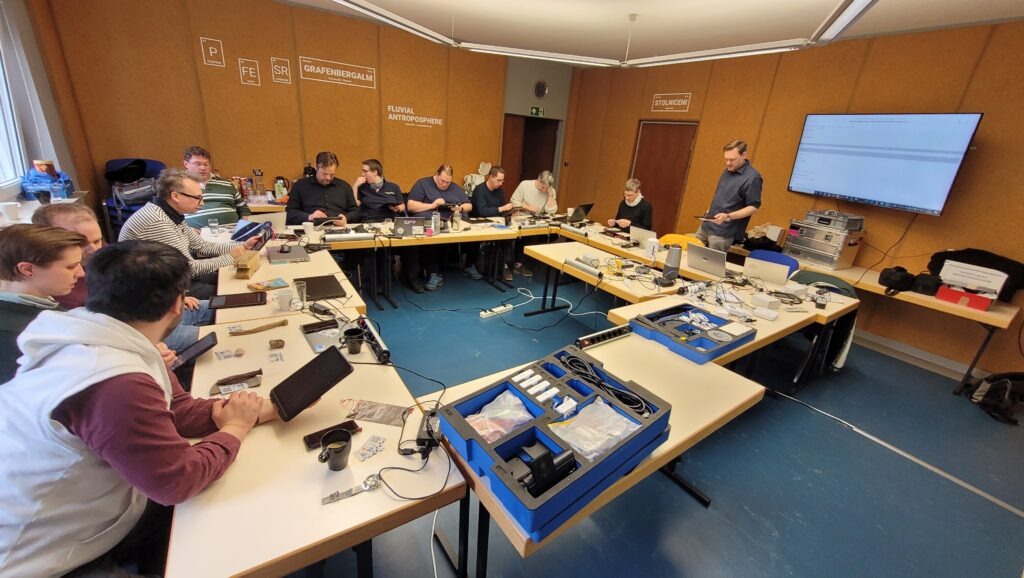
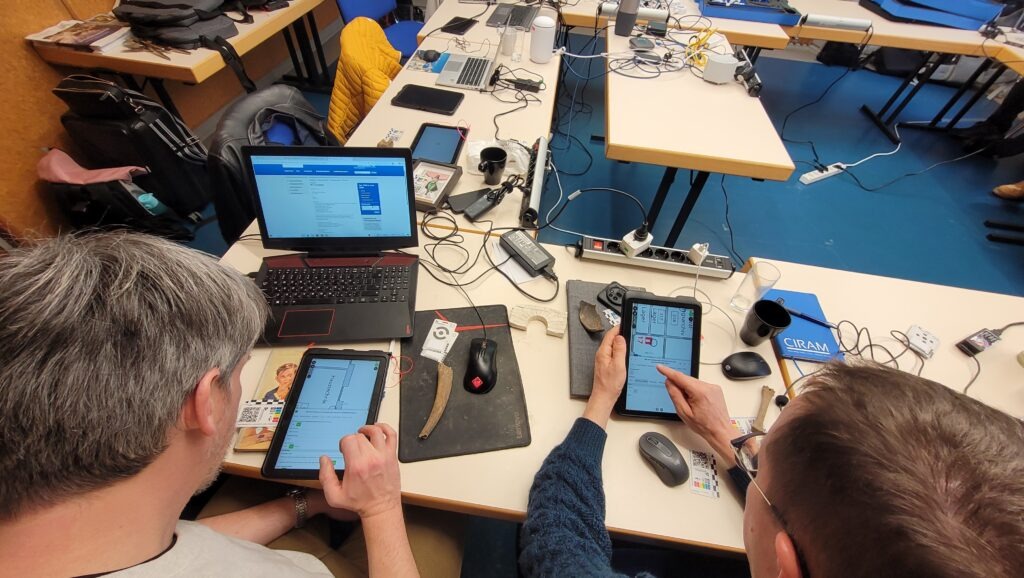
In March 2026, volunteer KulturGutRetter experts and THW personnel specialising in IT/ICT came together for the second IT training session as part of the KulturGutRetter project. Together, they practised setting up the IT infrastructure as part of a CHRU operation, configuring the digital documentation systems and carrying out practical procedures.
The Roman-Germanic Commission (RGK) of the German Archaeological Institute (DAI) in Frankfurt am Main graciously offered its premises for the event. Over the course of two days, participants worked with both the hardware used in network technology and the software for data collection in the field.
Photo: IT specialist training 2026 | E. Iacono, DAI
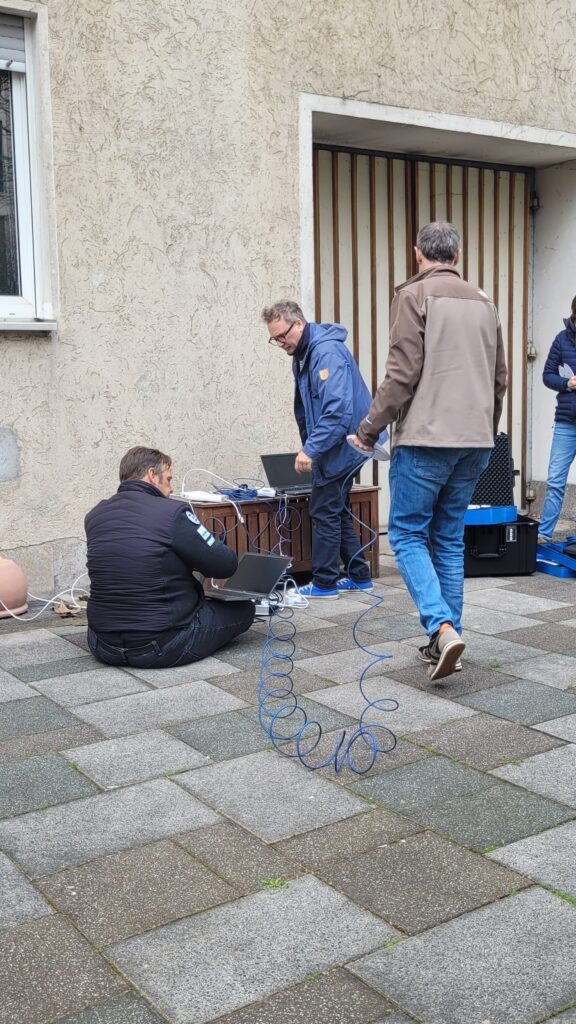
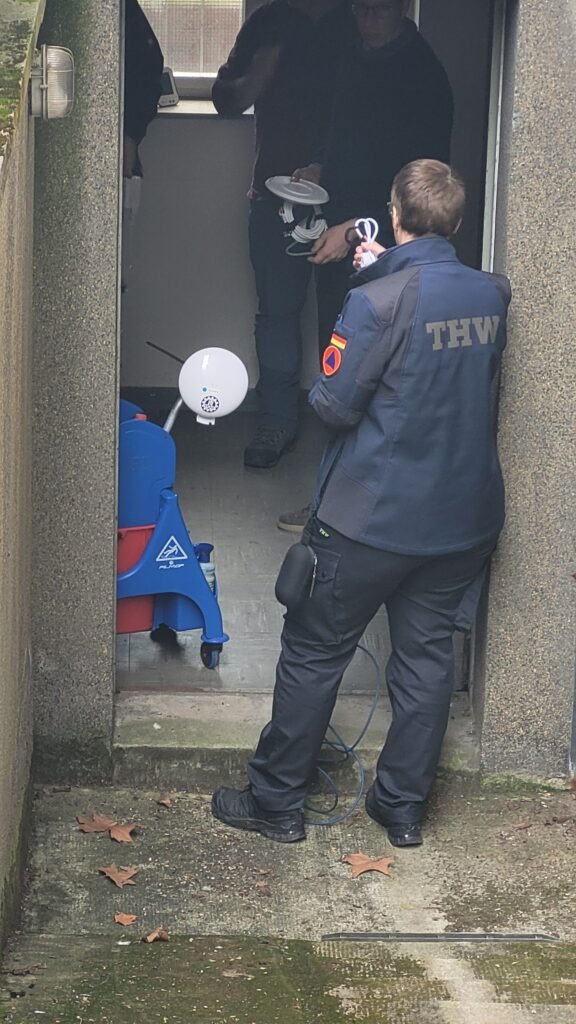
In collaboration with THW personnel from the ICT division, the new ‘Kit E’ was tested. This kit contains all the components needed to set up a comprehensive network during an operation. Within this network, data can be collected using mobile devices, for example. To this end, RGK access points were set up in the basement and garden and connected via cable or wireless. This enabled participants to document both movable and immovable cultural assets using the CHRU’s operational tablets throughout the entire network area. The data sets generated at various locations were uploaded live from the mobile devices to the shared database.
Photo: Test of “Kit E” | E. Iacono, DAI
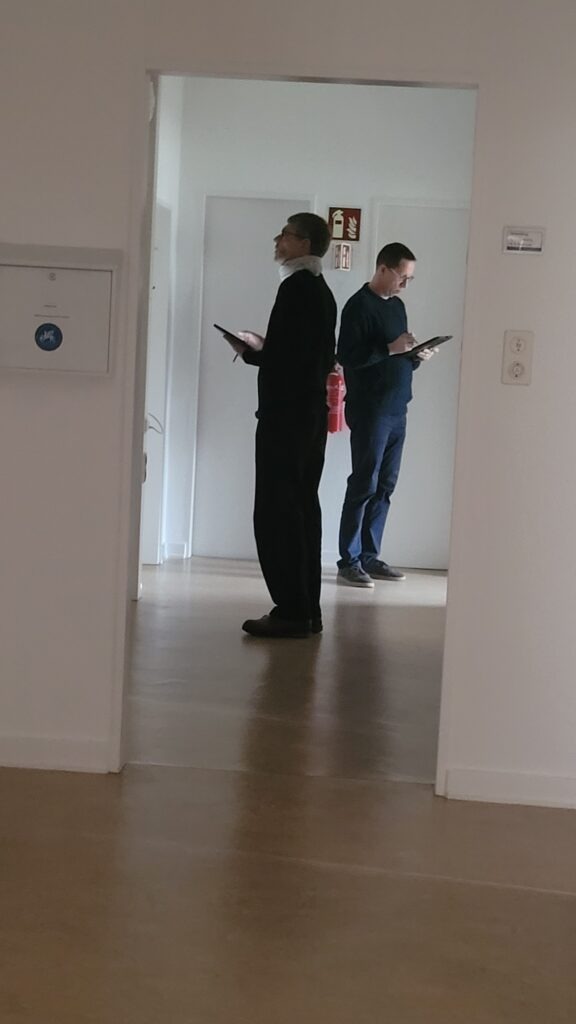
In addition to having a stable network, the second key element is the provision of forms and templates for digital documentation during operations. This requires some specific preparatory work to be carried out for each operation. This includes, amongst other things, creating a new documentation project, setting up users, and adding specific maps and information relating to the respective location. These processes are carried out by IT specialists using the open-source software QGIS and the QField/QFieldCloud app. A key focus is on sharing and synchronising data across different devices and amongst multiple staff members. The procedures were practised using KulturGutRetter-ID cards to provide CHRU members with processes that are as automated as possible when they are out in the field.
Photo: Preparation of forms and templates for digital documentation | E. Iacono, DAI
In particular, cooperation and mutual understanding of each other’s roles between the IT experts and the ICT response teams were successfully strengthened. The participants were also prepared to act independently as IT experts at future events and to pass on their knowledge to MCA and ICA experts, as well as THW personnel from the CHRU, whether as trainers during an exercise or directly in an operational deployment.
MCA specialist training
A few days later, experts from the MCA Unit met at LEIZA in Mainz. The main focus of this specialist training was: “What happens to our cultural heritage when water becomes a threat?”
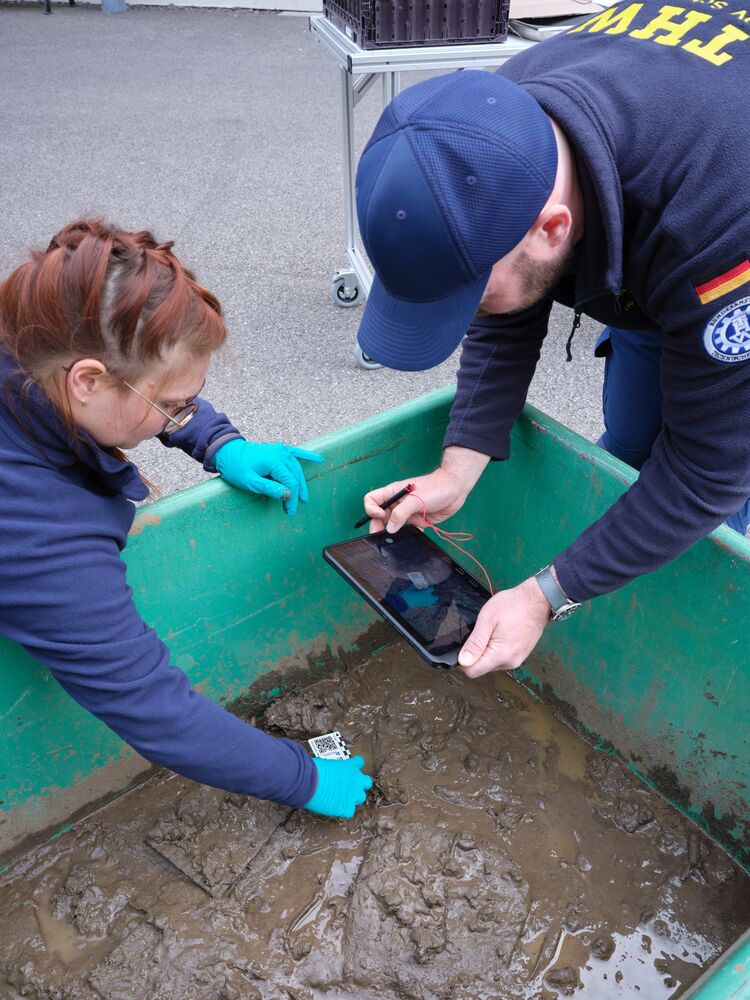
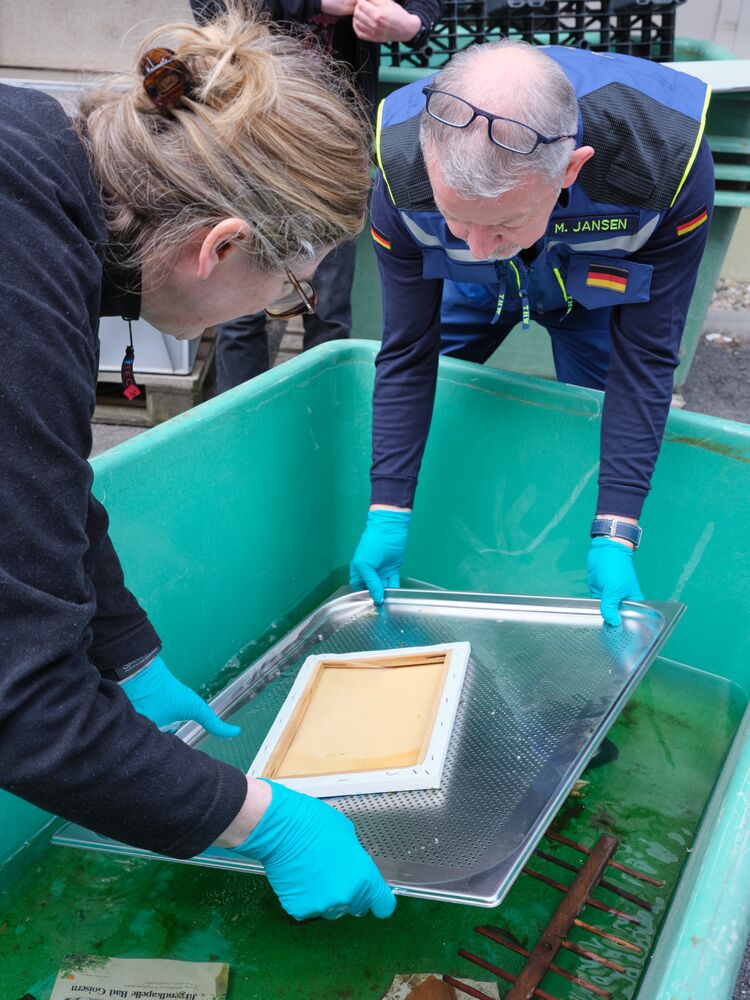
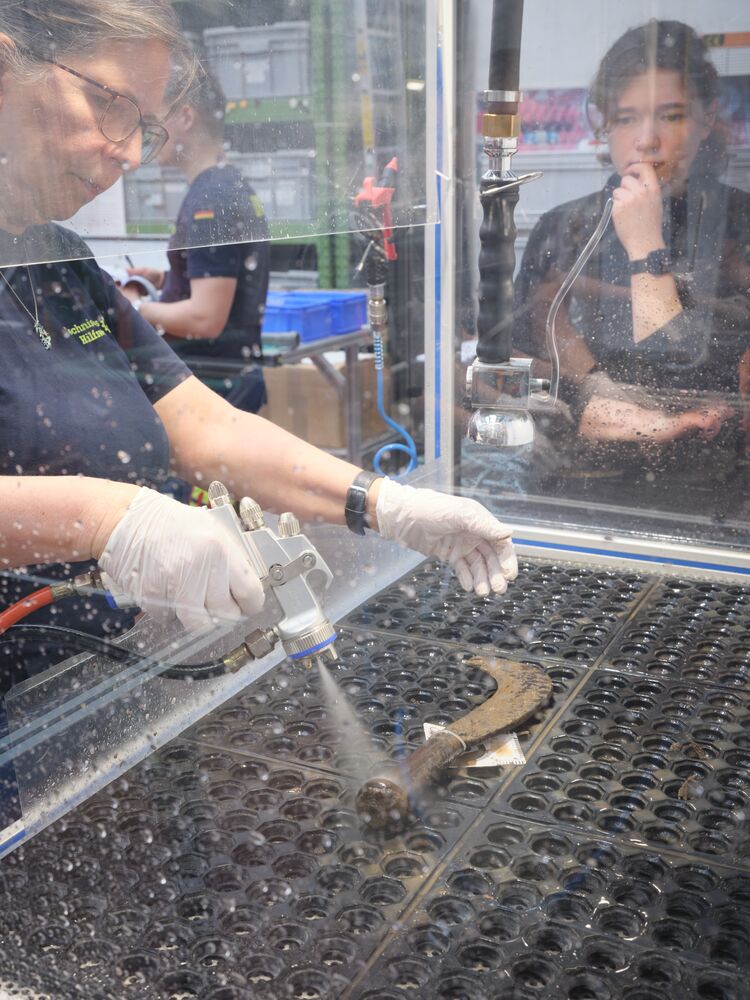
Photos: Identification of objects to be recovered using an ID card; method for recovering an object from the water; wet cleaning | R. Müller, LEIZA.
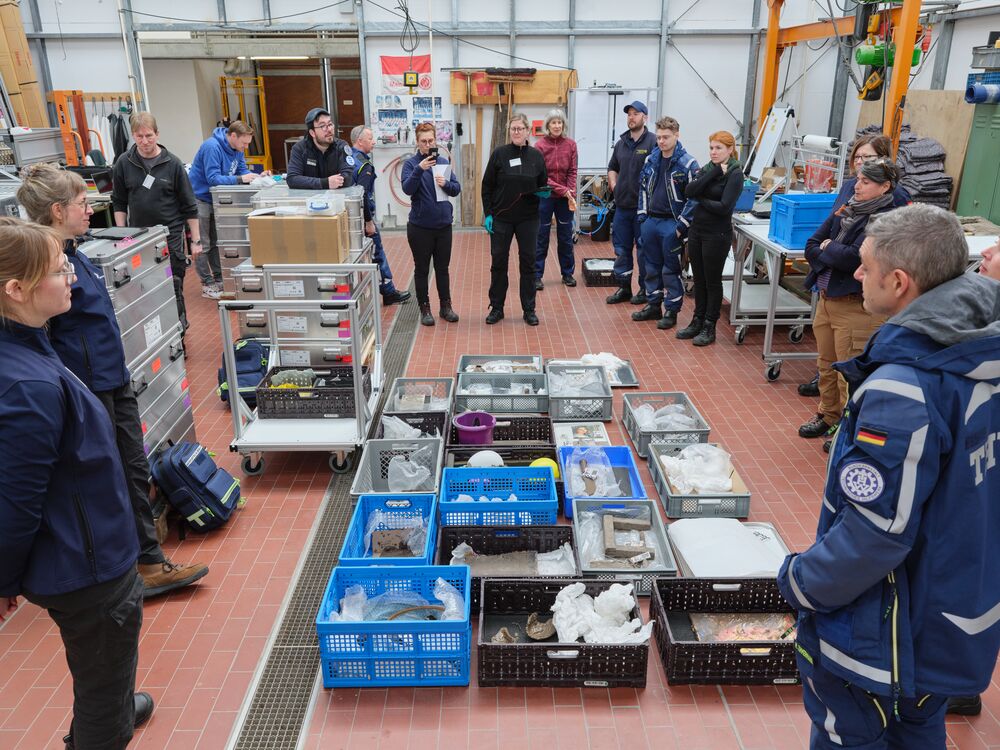
For four days, fourteen CHRU volunteers for movable cultural assets and four LEIZA staff members immersed themselves in simulated scenarios. Three large containers were prepared for this purpose, each containing twelve training objects from twelve different material groups: 1. Stagnant water, to simulate heavy rain. 2. Fire-fighting water containing soot, as after a fire. 3. Mud, in the event of a flood.
Each participant was assigned one object per scenario. As the participants were divided into teams of two, each team was able to process six objects and six groups of materials through the process. The participants then moved through several stages of the emergency conservation laboratory: documentation and recovery; triage; wet cleaning and alternative measures; and finally drying. Each station was then discussed in the whole group so that everyone could share their experiences, and the key points could be conveyed to everyone.
To learn the practical procedures at each station, both analogue and digital documentation methods were used, supported by worksheets and tablets. The practical part of the exercise was preceded by an introduction to QField and the CHRU’s digital documentation process. Two IT experts oversaw the entire training process and provided active support.
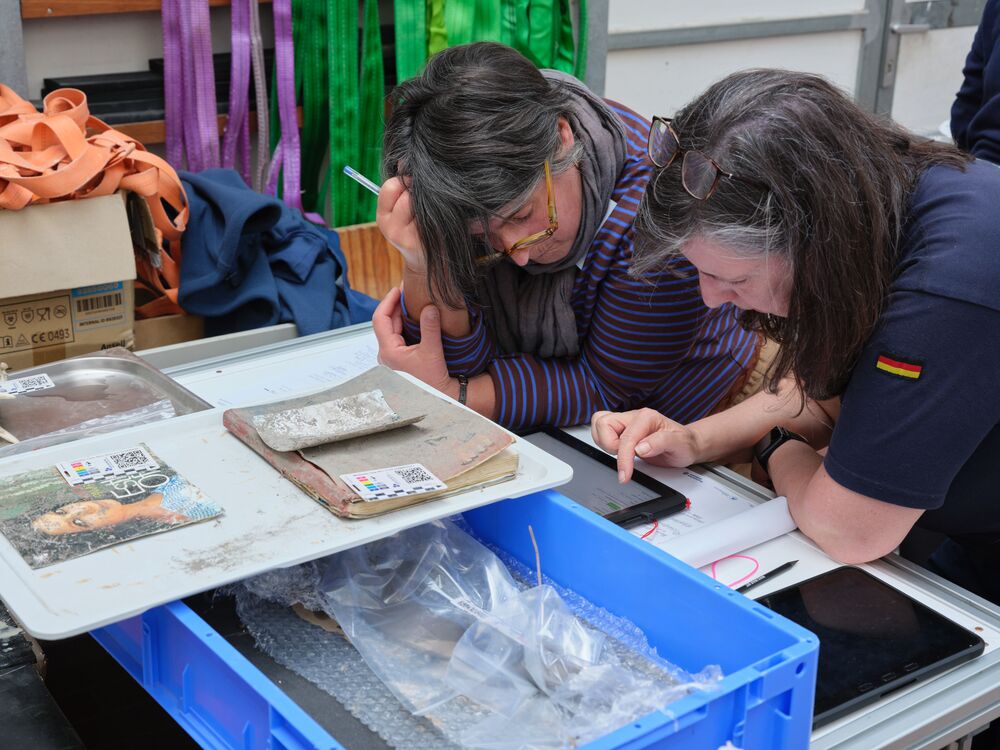
Photo: Digital recording of evacuated items | R. Müller, LEIZA
At the Documentation and Recovery Station, participants were challenged to find creative solutions for recovering fragile objects and securing them for transport. As in a real-life scenario, ID cards were handed out in advance and the objects were documented on site using tablets.
At the triage station, questions such as ‘How do we prioritise tasks in the emergency laboratory and why?’ and ‘What exceptional circumstances might arise?’ were addressed.
At the wet cleaning station, the participants first familiarised themselves with the module’s various functions – the oscillating spray nozzle, airbrush and cleaning attachment – before trying out how to handle the different materials. Particular emphasis was placed on the correct procedure for wrapping books and archival materials.
Drying methods such as the ‘wind tunnel’ or ‘hood drying’ were tested in a Mastertent. This involved the use of fan heaters, fans, building dryers, and specially made vapour-permeable hoods. The drying process was monitored using hygrometers and a set of scales. The process was digitally documented in QField, and object tracking was tested using an additional analogue numbering system.
Photo: Recovered objects | S. Steidl, LEIZA
Logistical issues that may arise during the mission were also covered in the specialist training. Upon arrival in the country of deployment, the first step is to draw up a pallet list of the numerous stacks of aluminium crates; the transport crates are then distributed and stored in a logical manner. The team also practised the exit strategy for handling the wet cleaning module. Cleaning, drying, packing – all of this takes time.
The close integration of theoretical knowledge and practical application made the MCA specialist training particularly impactful – and demonstrated once again how important preparation, collaboration and professional expertise are in the field of cultural heritage conservation. The event was not only a professional success, but was also characterised by lively discussion and a shared sense of purpose.