Since 2022, the German Archaeological Institute (DAI) and the German Federal Agency for Technical Relief (THW) have been active partners in the European projects PROCULTHER-NET (2022–2023) and PROCULTHER-NET2 (2024–2025). Both projects have achieved major results in bridging the gap between civil protection and cultural heritage protection at a European level.
PROCULTHER-NET2 officially concluded in March 2026 with a final conference held at the Royal Institute of Artistic Heritage (KIK-IRPA) in Brussels. KIK-IRPA was instrumental in responding to the floods that affected Belgium in the summer of 2021 and has since been working to improve preparedness and response for cultural heritage. Hilde De Clercq, Director General of KIK-IRPA, and Giovanni de Siervo, PROCULTHER-NET 2 Project Director (Italian Civil Protection Department), welcomed over 200 participants, both online and in person, from the civil protection and cultural heritage community.
Opening addresses were delivered by senior representatives from the EU Directorate-General for Civil Protection and Humanitarian Aid Operations (DG ECHO), the European External Action Service (EEAS), the UNESCO Liaison Office in Brussels, and the United Nations Office for Disaster Risk Reduction (UNDRR). Their attendance at the PROCULTHER-NET2 Final Conference highlights the progress made in integrating cultural heritage protection more effectively into civil protection procedures at local, national, and European levels. This is now widely recognised as a vital part of crisis prevention and preparedness, as well as in building the resilience of affected communities.
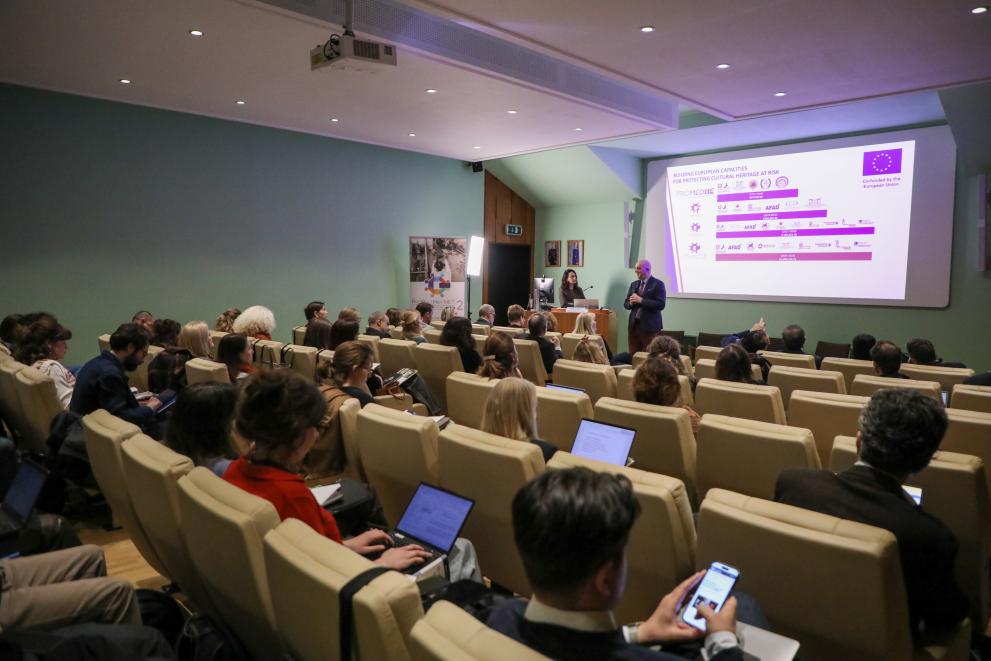
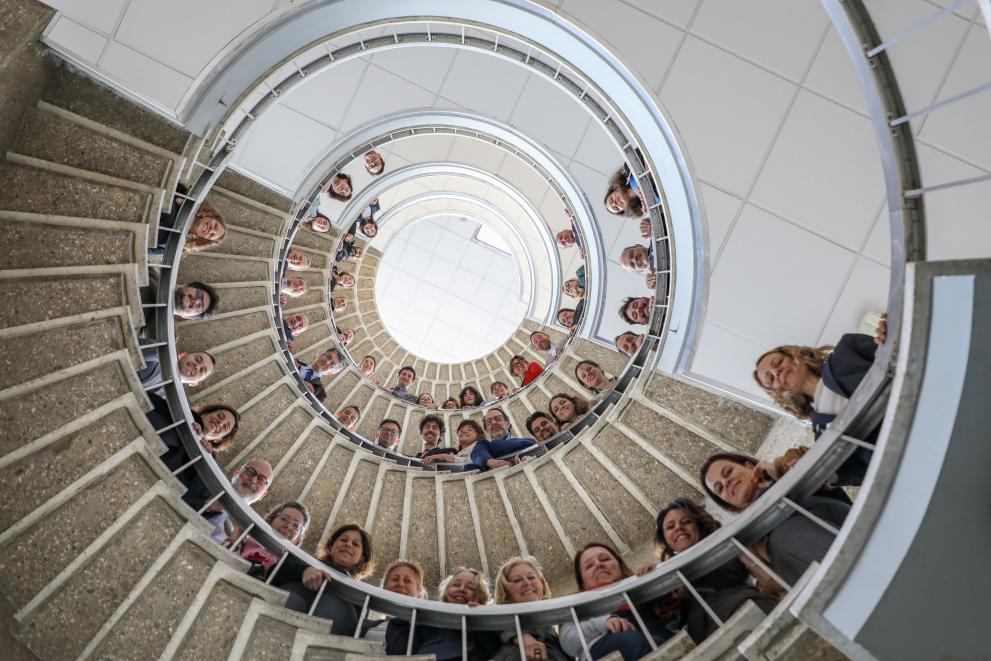
Participants during the PROCULTHER-NET 2 Final Conference hosted by the Royal Institute for Cultural Heritage (KIK-IRPA) in Brussels © DPC
Achievements of the PROCULTHER-NET2 Consortium
Led by the Italian Civil Protection Department, the Consortium partners – representing Italy, France, Germany, Portugal, Spain, and Türkiye – were responsible for several deliverables, including organising national and European workshops, delivering training sessions for Union Civil Protection Mechanism (UCPM) Member and Participating States, and publishing Technical Bulletins.
One of the major achievements of the successive PROCULTHER projects was the definition of a new Cultural Heritage Protection Module (CHP) within the UCPM. As per the Commission Implementing Decision (EU) 2025/704 of 10 April 2025, CHP modules contribute to protecting/safeguarding movable, immovable, and intangible cultural heritage through tasks, such as:
- risk assessment and/or damage assessment,
- cultural heritage emergency management,
- cultural heritage information management,
- emergency planning and damage mitigation techniques,
- securing, recovering cultural heritage assets,
- providing support to Post Disaster Needs Assessment (PDNA).
As of Spring 2026, two countries, France and Germany, have registered CHP modules. The German Cultural Heritage Response Unit (CHRU) has been officially registered in the European Civil Protection Pool (ECPP), and can be deployed through the UCPM after an international call for assistance. This major achievement is the result of the project KulturGutRetter, developed over the last years by the DAI, together with the THW and the Leibniz-Institute for Archaeology (LEIZA).
Another achievement of PROCULTHER-NET2 was to update the “Key Elements for a European Methodology for the Protection of Cultural Heritage at Risk of Disasters”, which was originally published in 2022. This is the first and only document to establish standardized, multi-sectoral procedures to integrate cultural heritage preservation into civil protection emergency management. The updated publication includes new contributions and case studies, including those from Germany, which did not participate in the original publication. Following several expert meetings and a workshop to test their efficiency in simulated conditions, the templates for the documentation and damage assessment of cultural heritage affected by a disaster were also updated. In addition to templates for movable and immovable heritage, templates for intangible heritage have now been added.
German contribution TO thE PROJECT
During the Final Conference, each participating country was given the opportunity to share the results and lessons learned from PROCULTHER-NET2. The German presentation was given jointly by representatives of the DAI and the THW, Germany being the only country to participate in PROCULTHER-NET2 with both a cultural heritage and a civil protection partner, mirroring their close collaboration in developing the CHRU.
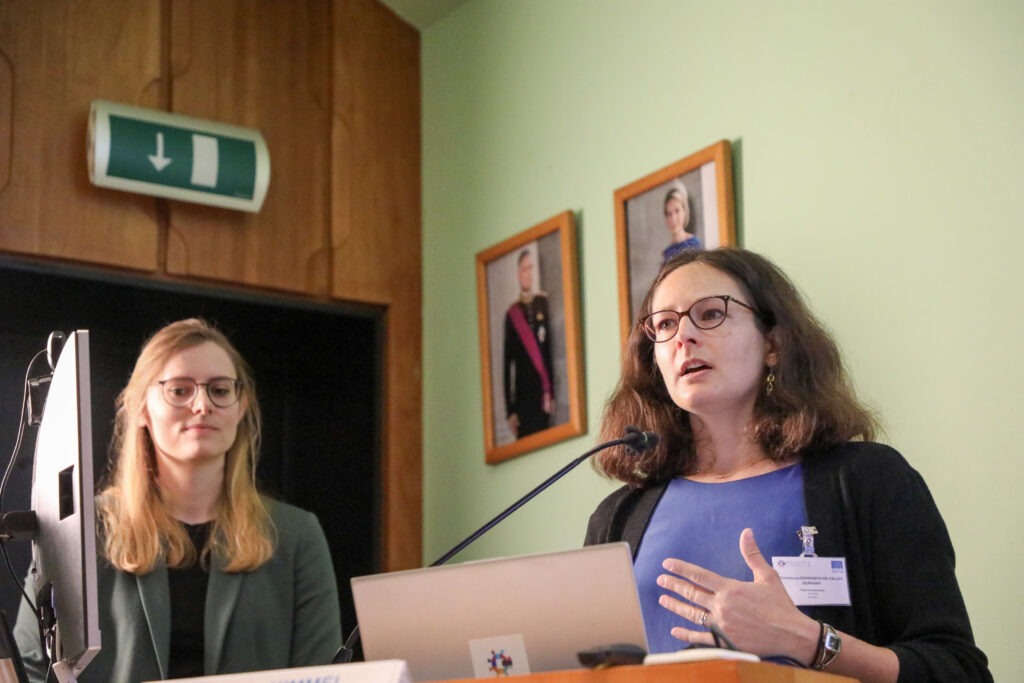
Presentation of the German results during the PROCULTHER-NET2 Conference, Photo: DPC
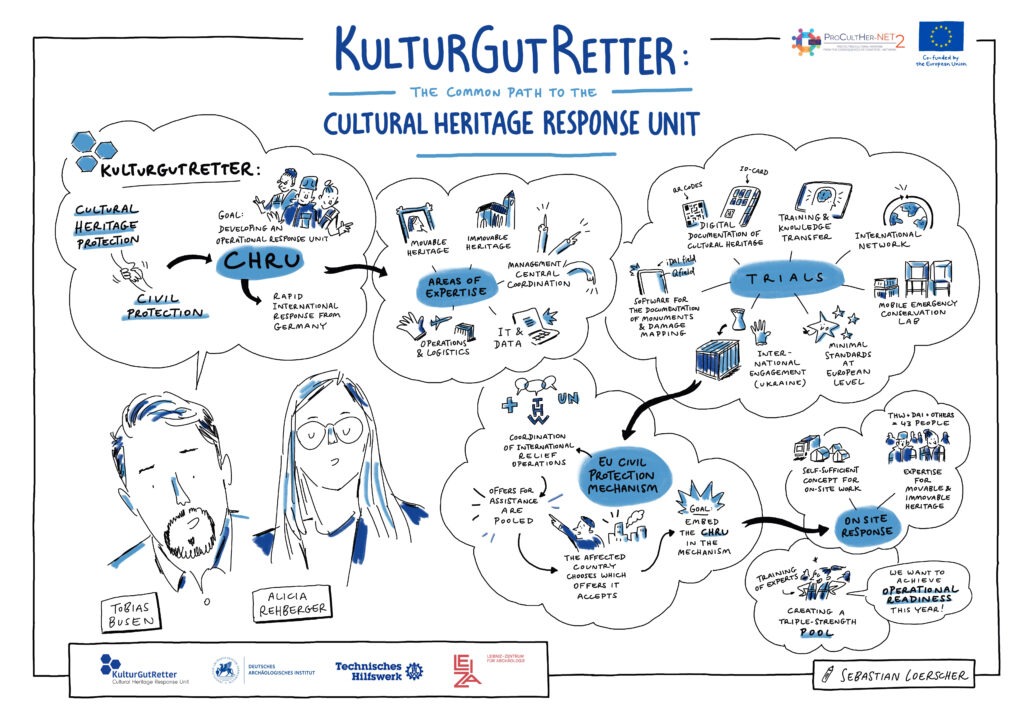
The THW and the DAI contributed to PROCULTHER-NET2 in several ways, bringing forward lessons learned and best practices acquired through the project KulturGutRetter and during the development of the CHRU.
- In October 2024, the CHRU participated in a unique European Module Exercise (Modex) in the lagoon of Venice, which included a team dedicated to protecting cultural heritage. The CHRU sent a seven-strong ‘skeleton team’ to document damage and evacuate artefacts from various sites. This unique experience was the opportunity for the CHRU to test its procedures and its compatibility with other disaster relief teams in a realistic scenario.
- To facilitate the exchange of information between the European and national levels, an online national workshop entitled ‘Yesterday-Today-Tomorrow: Where Does the Protection of Cultural Heritage Stand in 2030?’ was held in April 2025. It brought together over 50 participants from the German civil protection and cultural heritage sectors. The workshop provided an opportunity to reflect on past achievements, report on current developments, and consider future perspectives, to improve collaboration, preparedness, and response capacities for cultural heritage in times of crisis.

The CHRU in Venice during the 2024 MODEX. Photo: T. Busen, DAI
Presentation of the project KulturGutRetter at the German national workshop. Illustration: S. Lörscher
- In June 2025, a two-day study visit was organised for the PROCULTHER-NET2 partners at the THW logistics centre in Hilden, where the CHRU equipment is stored. 20 cultural heritage and civil protection experts from Italy, France, Portugal, and Türkiye took part in the visit. With the collaboration of LEIZA, which developed a mobile emergency conservation laboratory, the CHRU’s specialised equipment for movable and immovable cultural heritage was showcased, and the lessons learned during its development were shared with participants.
- In February 2026, two CHRU volunteers — one from the THW and one from the cultural heritage sector — joined a group of 80 European experts in Bursa, Türkiye, for a workshop dedicated to testing the documentation and damage assessment templates developed by PROCULTHER-NET2 for movable, immovable, and intangible heritage. Their experience with the CHRU templates proved invaluable in evaluating the European templates and suggesting improvements.
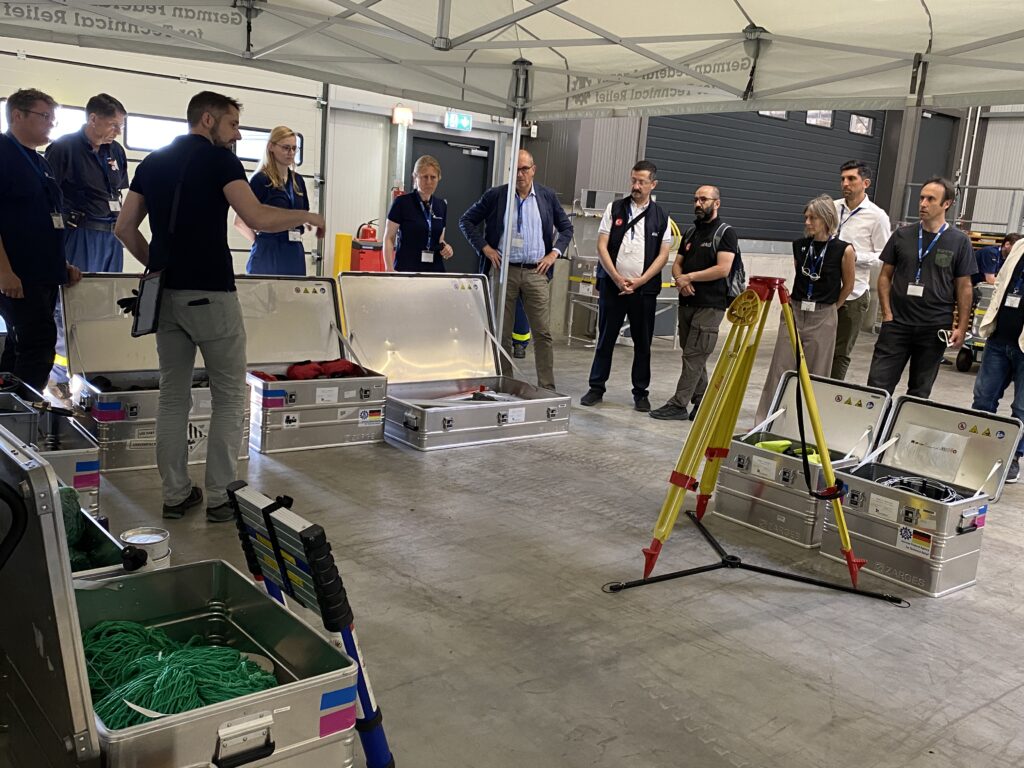
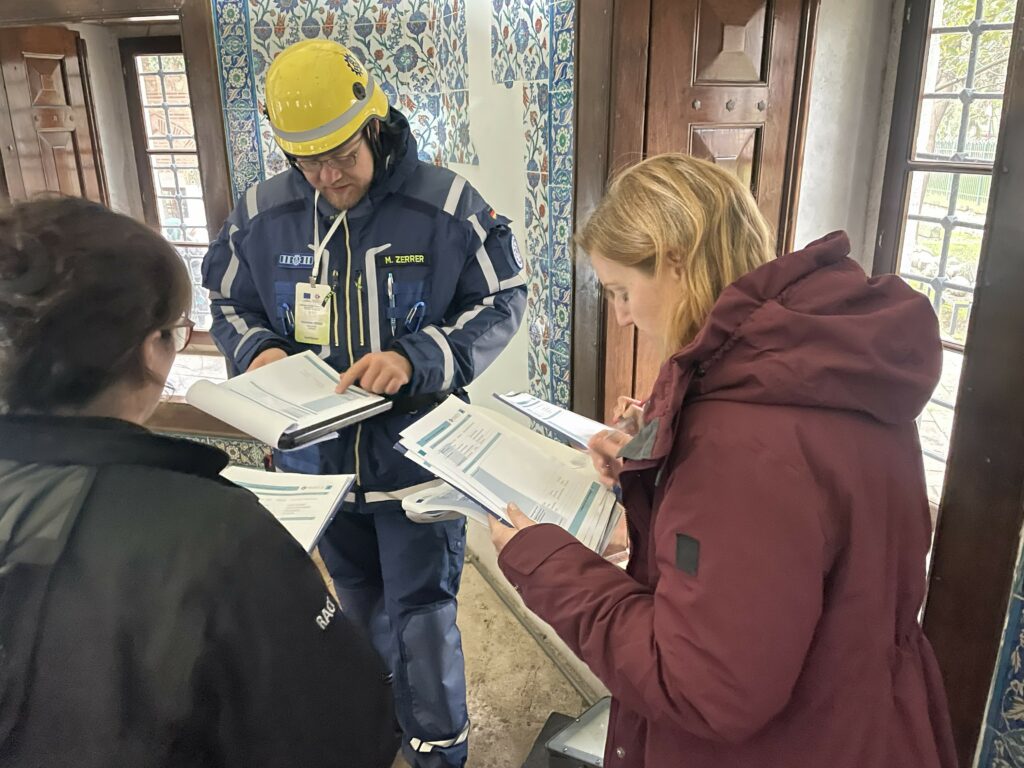
Study Visit at the THW Logistic Center in Hilden. Photo: C. Domenech, DAI.
A CHRU volunteer at the workshop in Bursa, Türkiye. Photo: C. Domenech
- Throughout the project, the CHRU sent eight of its volunteers – four from each sector – to PROCULTHER-NET2 training sessions organised in Caserta, Italy. During the week-long course, the CHRU volunteers gained theoretical and practical experience, developed links with European colleagues, and confirmed that the CHRU meets European standards.
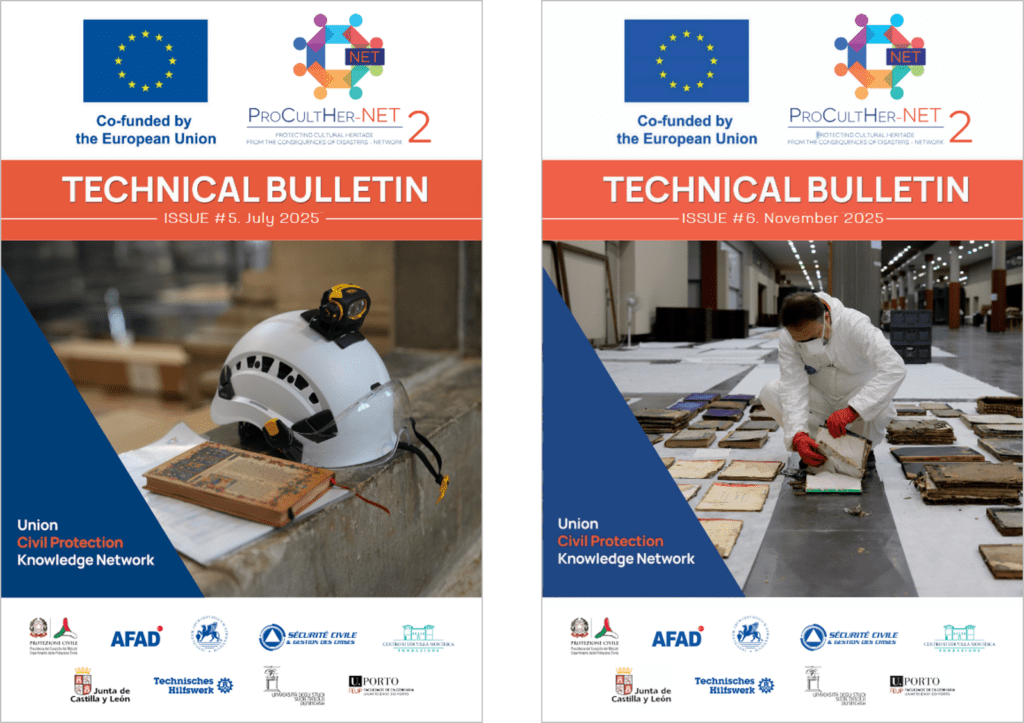
- Finally, the DAI was responsible for the editorial coordination of the Technical Bulletins, a publication aimed at the European thematic community focusing on the protection of cultural heritage at risk of disaster. Twice a year, the Technical Bulletins feature case studies, best practices, and lessons learned from civil protection and cultural heritage experts. Four Technical Bulletins were published during the project. Several articles showcased best practices from German organisations, while the DAI and THW contributed articles on the development of the CHRU.
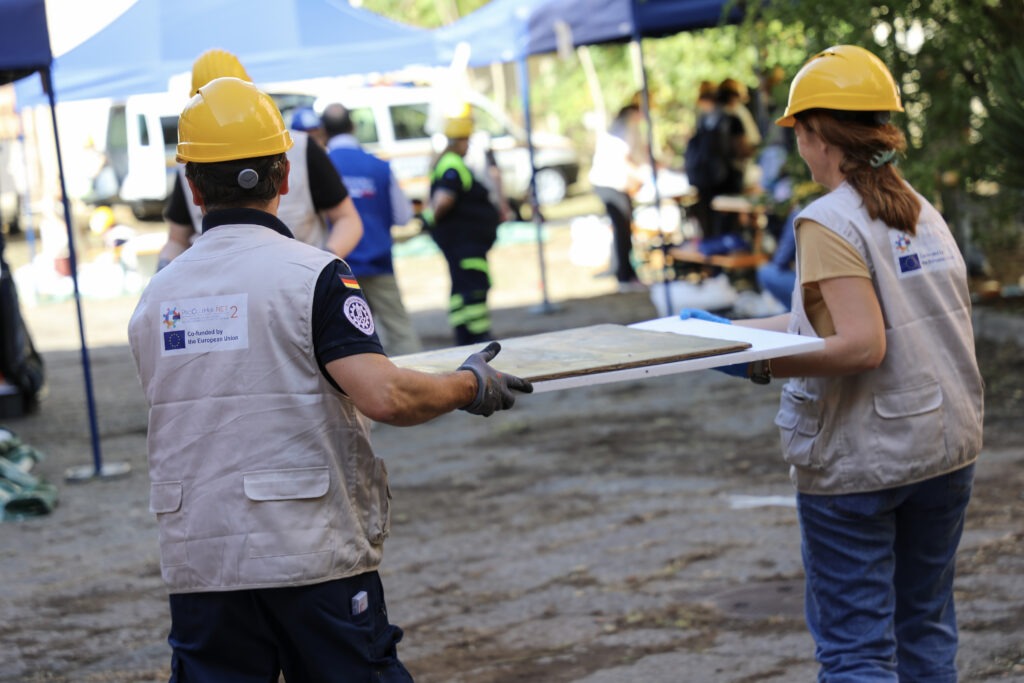
PROCULTHER-NET2 Training in Caserta. Photo: Italian DPC.
Covers of the Technical Bulletin #5 and #6. Image: PROCULTHER-NET2.
Next steps toward European integration
The follow-up project PROCULTHER-4ALL launched in April 2025, for two years. The DAI and THW will continue to participate in the project as, respectively, Consortium partner and associated partner. UNESCO, Poland, Romania, and the Consortium for the coordination of research activities concerning the Venice lagoon system (CORILA) will join the project. Building on previous achievements, the goal is to further integrate cultural heritage and civil protection by promoting a whole-of-government and a whole-of-society approach.
Developments in PROCULTHER-4ALL will continue to inform the KulturGutRetter project and the CHRU, and vice versa, ensuring common standards and practices.